
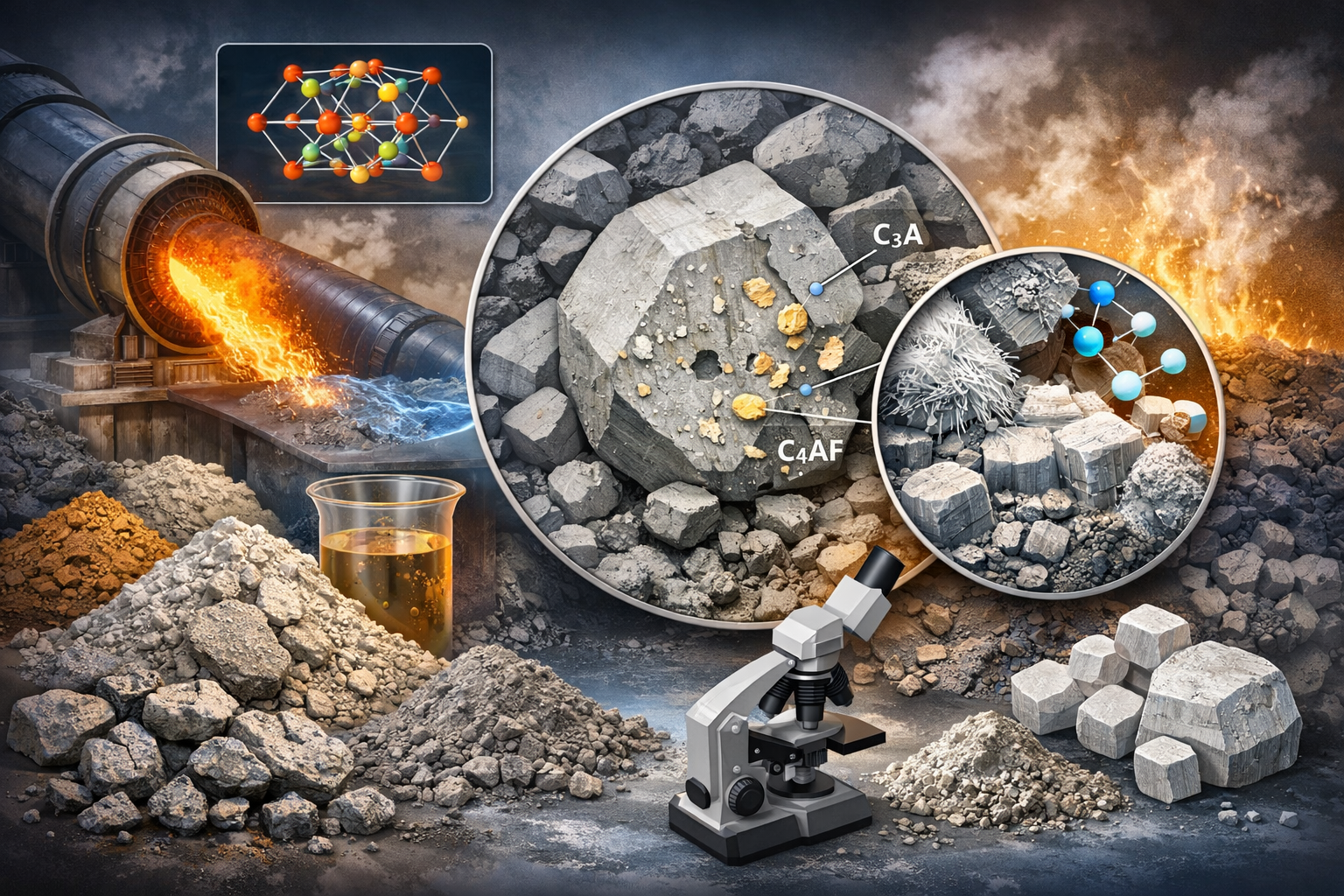
C₃S in Clinker: Formation, Structure, Reactivity, and Industrial Significance
1. Identity of C₃S: The Core Mineral of Early Strength
Tricalcium silicate (C₃S), known as alite, is the most influential component of Portland clinker. Its approximate formula is:
3CaO · SiO2
It typically represents 50–70% of the clinker, and is primarily responsible for:
- Early mechanical strength (1–7 days)
- High heat of hydration
- Rapid development of cement microstructure
Modern clinker engineering revolves around maximizing C₃S formation and reactivity while maintaining stability and energy efficiency.
2. Formation of C₃S: The Thermal Alchemy of the Kiln
2.1. Thermodynamic Conditions
C₃S forms mainly between 1250–1450 °C, through the reaction of:
- C₂S (belite)
- Free CaO (lime)
- Fluxes and liquid phases
Global reaction:
2CaO · SiO2 + CaO → 3CaO · SiO2
2.2. Key Formation Factors
- Peak kiln temperature: stable between 1400–1450 °C
- Liquid phase content: ideally 23–28%, enabling ionic diffusion
- Raw meal fineness: fine, homogeneous feed promotes complete reaction
- Residence time: too short → high free lime; too long → coarse crystals
- Raw material mineralogy: reactive clays, pure limestone, and balanced fluxes (Fe₂O₃, Al₂O₃, MgO) enhance formation
3. Crystal Structure: Why C₃S Is So Reactive
C₃S exhibits polymorphism, with several crystalline forms:
- Triclinic (T1, T2)
- Monoclinic (M1, M2, M3)
- Rhombohedral (R)
Monoclinic forms dominate modern clinker and are the most reactive.
3.1. Influence of Dopants
Elements such as:
- Al³⁺, Fe³⁺, Mg²⁺, Na⁺, K⁺
enter the crystal lattice, stabilizing high-temperature phases and increasing reactivity — explaining why industrial C₃S is more reactive than pure laboratory C₃S.
4. Microstructure of C₃S in Clinker
4.1. Typical Morphology
C₃S crystals are:
- Elongated or pseudohexagonal
- 10–60 µm in size
- Rounded edges due to liquid phase interaction
4.2. Internal Inclusions
C₃S often contains microinclusions of:
- Solidified liquid phase (C₃A, C₄AF)
- Substitutional ions
- Micropores
These inclusions increase internal surface area, accelerating hydration.
5. Hydration of C₃S: The Engine of Early Strength
Main reaction:
2C3S + 6H → C3S2H3 (C-S-H) + 3CH
Produces:
- C‑S‑H gel → the strength-bearing phase
- CH (calcium hydroxide) → hexagonal crystals
5.1. Kinetics
- Short induction period
- Rapid C‑S‑H growth
- Strong exothermic peak
5.2. Effects on Cement Properties
- High early strength
- Elevated heat of hydration
- Lower sulfate resistance (due to CH)
- Higher water demand
6. Controlling C₃S in Plant Operations
6.1. Operational Variables
- Kiln temperature profile
- Kiln rotation speed
- Fuel dosage and distribution
- Raw meal particle size
- Flux content
6.2. Chemical Variables
- LSF (Lime Saturation Factor): ideal 95–98%
- SM (Silica Modulus): controls C₂S/C₃S ratio
- AM (Alumina Modulus): affects liquid phase amount
6.3. Risks of Poor C₃S Control
- High free lime: expansion, irregular setting
- Coarse crystals: low reactivity
- Overburning: excessive energy use
- Underburning: dusty clinker, poor quality
7. Industrial Importance of C₃S
C₃S governs:
- Early strength development
- Setting time
- Heat generation
- Process efficiency
- Compatibility with modern admixtures
In high‑early‑strength cements (Type III), C₃S content may exceed 70%.
8. Editorial Conclusion
C₃S is the heart of Portland clinker.
Its formation balances chemistry, thermodynamics, kinetics, and kiln operation. Deep understanding enables:
- Energy optimization
- Quality improvement
- Process stability
- Competitive performance
- Sustainable cement design
To master C₃S is to master clinkerization.