
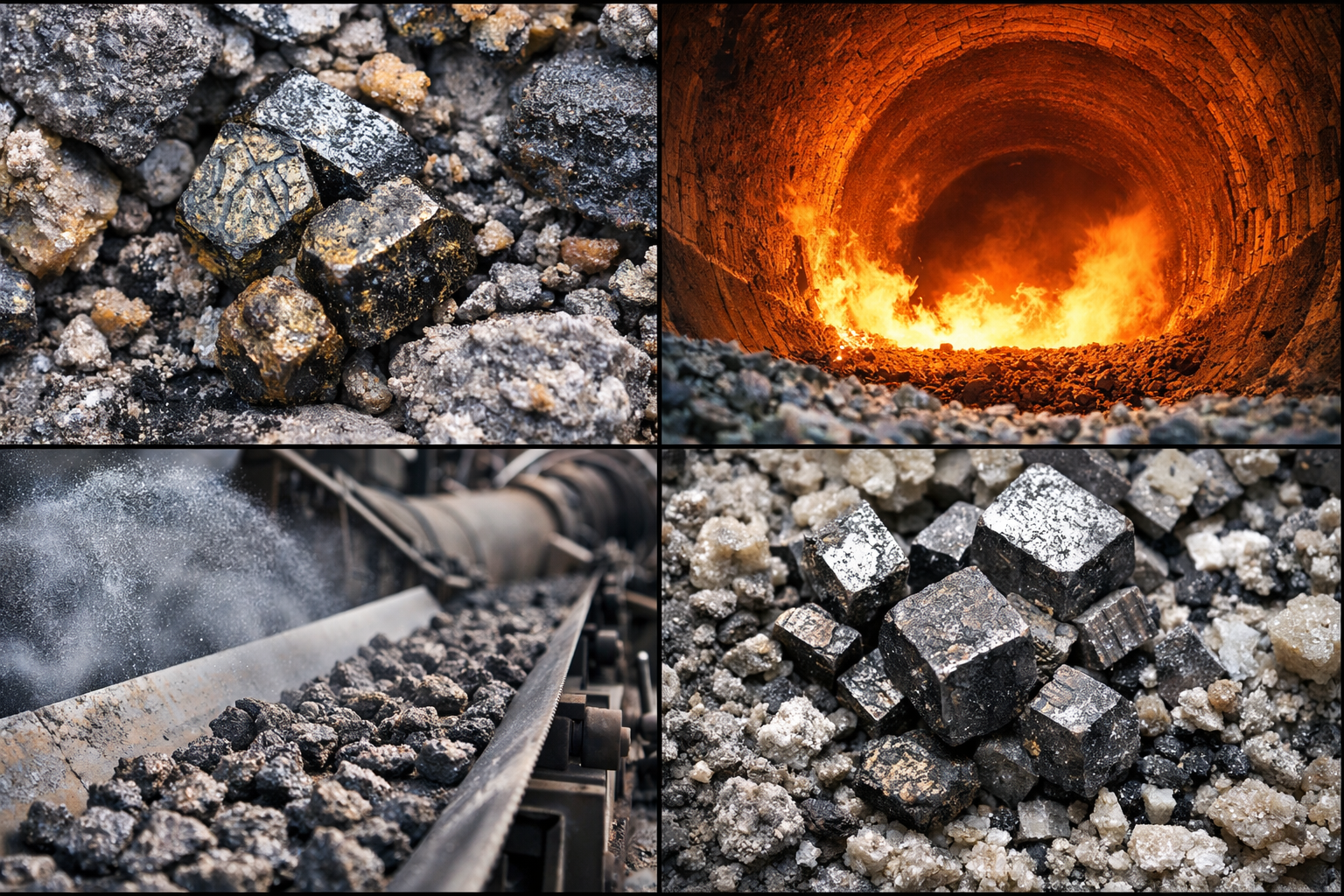
C₄AF in Clinker: Nature, Formation, Thermodynamics, and Functional Role in Cement Manufacturing
Tetracalcium aluminoferrite (C₄AF) is the ferrite phase of Portland clinker, an interstitial mineral that crystallizes from the melt and plays a decisive role in the reactivity of the system, the mobility of the liquid phase, the thermal stability of the kiln, and the processability of cement. Although its contribution to mechanical strength is limited, its impact on manufacturing, microstructural development, and cement performance is profound.
1. Mineralogical and Structural Identity of C₄AF
- Mineralogical name: Ferrite phase or tetracalcium aluminoferrite.
- Ideal formula: 4CaO·Al₂O₃·Fe₂O₃.
- Crystal structure: orthorhombic, brownmillerite-type.
- Real compositional range:
- Extensive Al³⁺ ↔ Fe³⁺ substitution, forming a continuous solid solution between C₂F and C₆A₂F.
- Minor incorporation of Ti⁴⁺, Mg²⁺, Si⁴⁺.
The brownmillerite structure consists of alternating layers of FeO₆/AlO₆ octahedra and AlO₄ tetrahedra, producing an anisotropic mineral with structural defects that influence its reactivity.
2. Formation of C₄AF in the Kiln: Thermodynamics and Kinetics
2.1. Formation stages
C₄AF forms mainly in the clinkerization zone, at 1,250–1,450 °C, through:
- Solid‑state reactions between CaO, Al₂O₃, and Fe₂O₃.
- Dissolution into the liquid phase generated by aluminates and ferrites.
- Crystallization from the melt during cooling.
2.2. Fe₂O₃ as a powerful flux
Fe₂O₃ is one of the most effective fluxes in the CaO–SiO₂–Al₂O₃–Fe₂O₃ system:
- Lowers the temperature at which the liquid phase forms.
- Increases melt fluidity.
- Facilitates C₃S formation by enhancing Ca²⁺ and Si⁴⁺ diffusion.
Without Fe₂O₃, clinkerization would require significantly higher temperatures and become energetically impractical.
2.3. Cooling rate effects
Cooling controls:
- Crystal size (rapid cooling → finer, more reactive crystals).
- Order–disorder transitions (slow cooling → more ordered, less reactive ferrite).
- Al/Fe distribution within the structure.
Rapid cooling produces a more disordered ferrite, which hydrates more readily.
3. Functional Roles of C₄AF in Clinker and Cement Manufacturing
3.1. Role in the kiln
- Primary flux: reduces clinkerization temperature.
- Liquid phase controller: adjusts viscosity and quantity.
- Thermal stabilizer: buffers raw mix variability.
- Promoter of C₃S formation.
3.2. Role in clinker
- Shapes the interstitial microstructure.
- Influences friability (higher C₄AF → easier grinding).
- Affects color (darker tones due to Fe).
3.3. Role in hydrated cement
Although less reactive than C₃A, C₄AF:
- Hydrates to form ferrite AFt and AFm phases.
- Reduces heat of hydration.
- Improves sulfate resistance compared to C₃A.
- Contributes to durability in moderately aggressive environments.
4. Hydration of C₄AF: Mechanisms and Products
Hydration of C₄AF is slower than that of C₃A due to:
- Lower solubility of Fe³⁺.
- Limited diffusion within the brownmillerite structure.
4.1. General reaction
C₄AF + 2–3 CaSO₄·2H₂O + 30–32 H →
→ ferrite ettringite (AFt‑Fe) + Fe/Al hydroxides + Fe‑bearing C–S–H gel (minor).
4.2. Characteristic products
- Ferrite ettringite (AFt‑Fe): more stable than aluminous ettringite.
- Ferrite monosulfate (AFm‑Fe).
- Mixed Fe–Al–Si gels.
Fe tends to precipitate as amorphous ferric hydroxide, limiting expansion and reducing susceptibility to chemical attack.
5. Influence of C₄AF on Cement Properties
5.1. Fresh properties
- Reduces water demand.
- Improves workability.
- Lowers early reactivity.
5.2. Mechanical properties
- Minor contribution to strength (<10%).
- Enhances long‑term strength in low‑C₃A cements.
5.3. Durability
- Better sulfate resistance than C₃A.
- Lower heat of hydration.
- Reduced risk of secondary ettringite expansion.
6. Controlling C₄AF in the Plant: Chemical and Operational Strategy
6.1. Chemical variables
- Fe₂O₃: primary controller of C₄AF.
- Al₂O₃/Fe₂O₃ ratio: determines C₃A/C₄AF balance.
- Free CaO: influences crystallization.
6.2. Operational variables
- Peak kiln temperature.
- Residence time.
- Cooling profile.
- Raw mix homogeneity.
6.3. Typical targets
- C₄AF between 8–12% for common Portland cements.
- Adjustments based on:
- sulfate resistance,
- color,
- heat of hydration,
- grindability.
7. Industrial and Strategic Importance of C₄AF
C₄AF is often underestimated, yet essential for:
- Energy efficiency of the kiln.
- Process stability.
- Clinker microstructure control.
- Grinding performance.
- Durability of cement.
- Flexibility in raw material selection (iron ores, ferruginous clays, industrial by‑products).
In the context of decarbonization, C₄AF becomes even more relevant because it enables:
- Lower clinkerization temperatures.
- Higher use of alternative raw materials.
- Production of cements with lower C₃S and higher SCM compatibility.
Conclusion
C₄AF is not merely a secondary phase: it is a thermodynamic and operational pillar of cement manufacturing. Its presence governs liquid phase formation, thermal stability, clinker microstructure, grindability, hydration, and cement durability. A deep understanding of C₄AF allows optimization of both production efficiency and final performance.