
Free Lime in Clinker: Origin, Structure, Impact, and Operational Control
1. Identity of Free Lime
Free lime (uncombined CaO) is the residual calcium oxide that did not fully react with silica, alumina, and iron oxides during clinker formation.
Its presence indicates incomplete phase formation (C₃S, C₂S, C₃A, C₄AF) and reflects chemical or thermal imbalance in the kiln.
1.1. Chemical nature
>900°C
CaCO3 →CaO + CO2
The resulting CaO must combine with SiO₂, Al₂O₃, and Fe₂O₃ to form the main clinker minerals. When this reaction is incomplete, CaO remains free, highly reactive, and potentially expansive.
2. Formation of Free Lime in the Clinkerization Process
2.1. Chemical causes
- Low silica content → insufficient SiO₂ to form C₃S and C₂S
- Excessive LSF (Lime Saturation Factor) → surplus CaO relative to acidic oxides
- Heterogeneous raw mix → uneven distribution of components
- Presence of MgO or alkalis → interferes with fusion and CaO reactivity
2.2. Thermal causes
- Insufficient temperature (<1400 °C) → incomplete reaction
- Short residence time → limited diffusion and combination
- Rapid cooling → premature crystallization
- Irregular thermal profile → cold or overheated zones in the kiln
3. Structure and Morphology of Free Lime
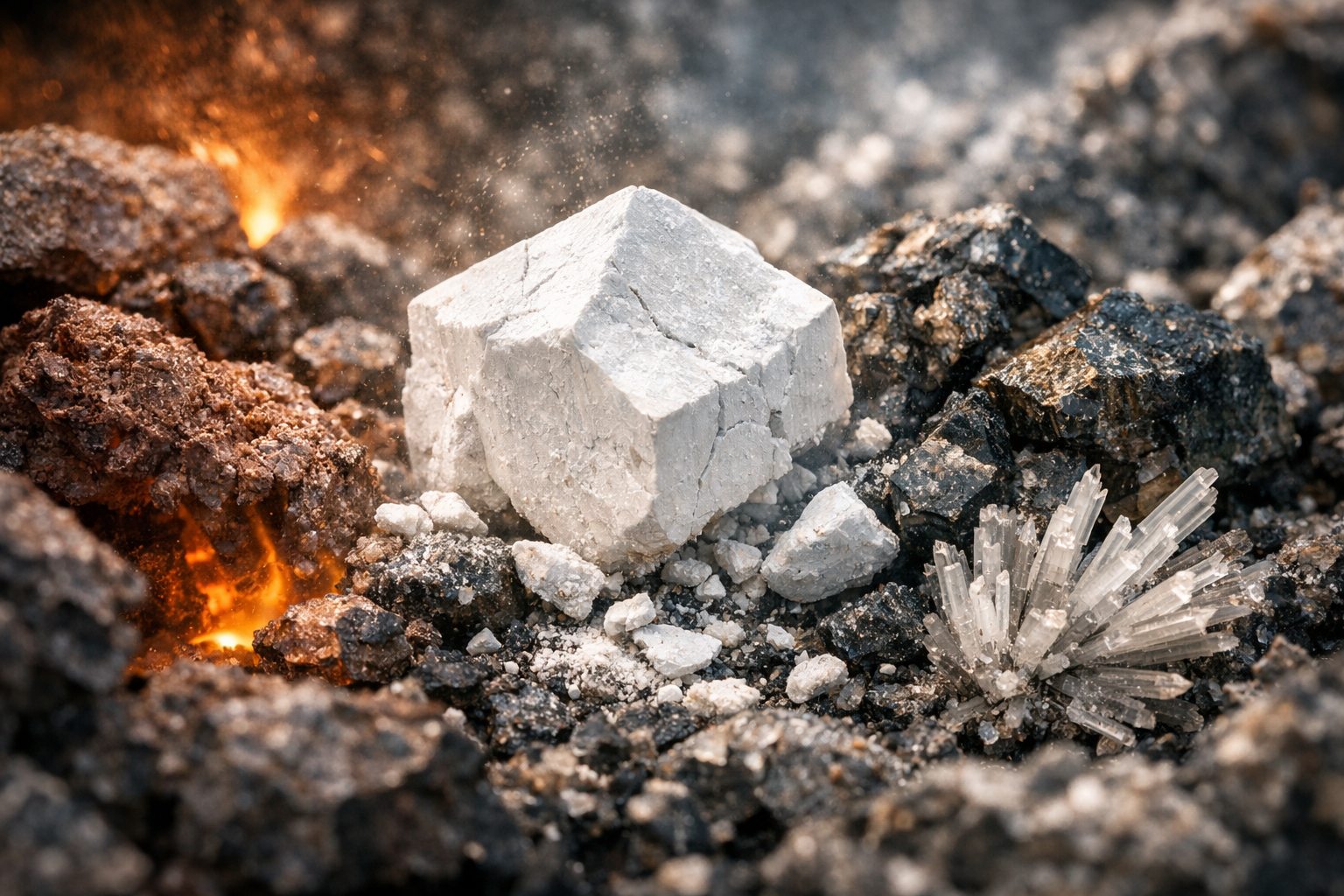
Free lime appears as cubic or granular crystals dispersed within the clinker matrix.
Under microscopy, it shows:
- Bright, isotropic crystals under reflected light
- Association with pores or microcracks
- Intergrowths with partially formed C₃S
Its size and distribution depend on fusion degree and cooling rate.
4. Effects of Free Lime on Cement
4.1. Expansion and cracking
During hydration:
CaO + H2O → Ca(OH)2
The volumetric expansion can reach up to 2.5 times the original volume, causing:
- Internal cracking
- Clinker disintegration
- Loss of mechanical strength
4.2. Setting variability
Free lime alters hydration kinetics, leading to:
- Irregular setting times
- High initial alkalinity
- Admixture incompatibility
4.3. Durability impact
- Promotes efflorescence and surface carbonation
- Reduces chemical resistance to sulfates and acids
- Increases porosity in hardened cement
5. Detection and Control Methods
5.1. Chemical testing
- Glycol or ethylene glycol method for CaO quantification
- XRD analysis to identify uncombined phases
- Optical microscopy for morphology and distribution
5.2. Operational control
- Maintain LSF within the optimal range (92–98)
- Keep clinkerization temperature between 1450–1500 °C
- Ensure raw mix homogeneity through proper grinding and blending
- Optimize kiln thermal profile and residence time
- Control cooling rate to prevent premature crystallization
6. Free Lime and Kiln Thermal Efficiency
Free lime is a direct indicator of thermal inefficiency.
Each percentage point of uncombined CaO implies:
- Lost chemical energy
- Higher fuel consumption
- Risk of ring formation and build‑ups
- Reduced clinker quality
Thus, controlling free lime is a critical variable in thermal governance.
7. Mineralogical and Process Perspective
Free lime should not be viewed merely as a defect but as a symptom of imbalance between:
- Thermodynamics (energy availability)
- Kinetics (reaction time)
- Diffusion (mixing and homogeneity)
Understanding it enables optimization of kiln design, flame profile, and raw mix composition, integrating chemical and thermal control into one strategy.
8. Editorial Conclusion
Free lime is the chemical mirror of the clinkerization process.
Its presence reveals the degree of thermal and chemical maturity of the clinker.
Controlling it enhances not only cement quality but also energy efficiency and operational stability across the plant.
Mastering free lime means mastering the chemistry of thermal perfection in clinker.