
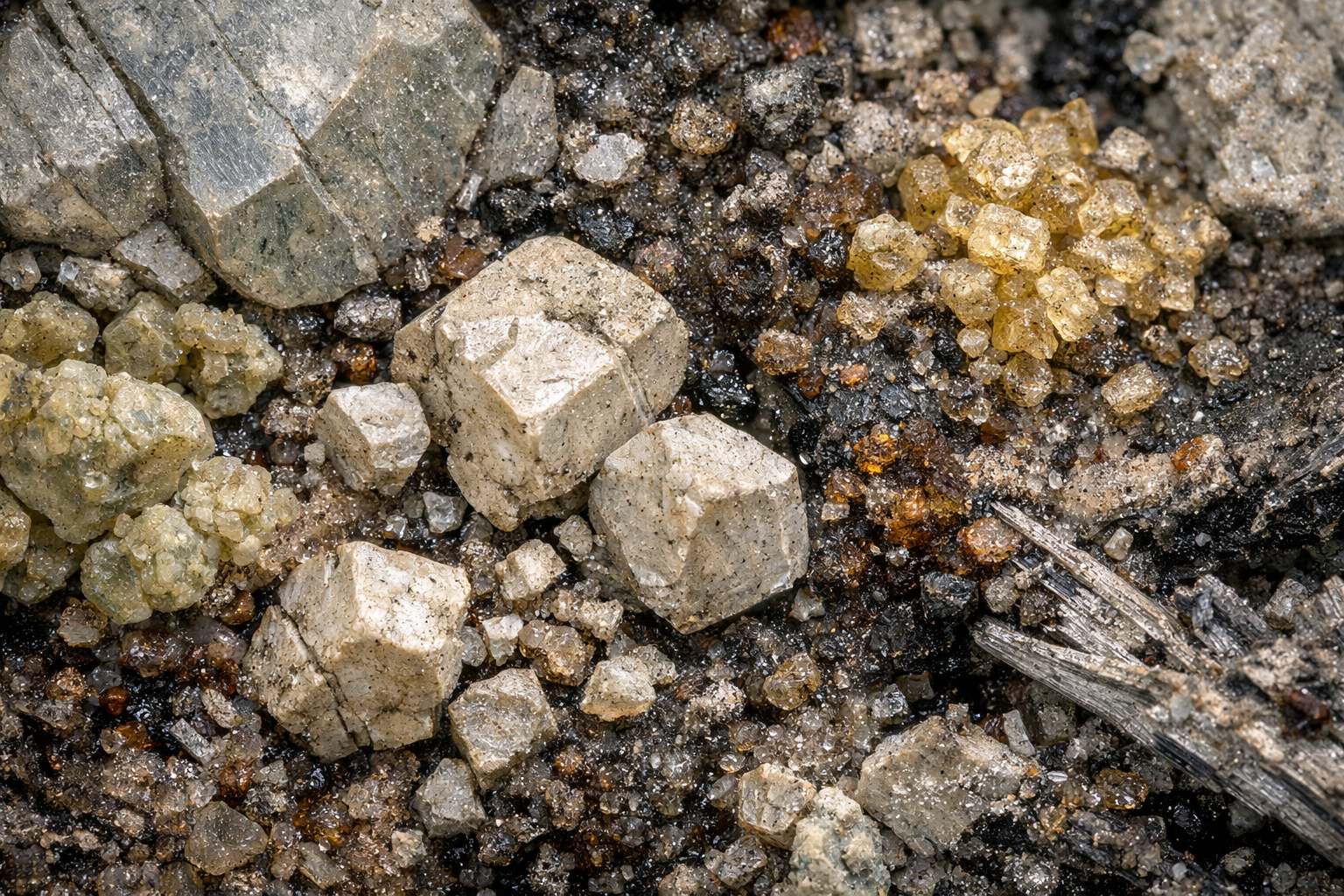
MgO in Portland Clinker: Behavior, Function, and Risks in the Sintering Process
Magnesium oxide (MgO) is one of the most influential minor components in Portland clinker. Although typically present between 0.5 and 5%, its impact on mineralogy, reactivity, volumetric stability, and microstructure is substantial. Its behavior depends critically on its origin, its crystalline state, its solubility in clinker phases, and the thermal conditions inside the kiln.
1. Sources of MgO in Raw Materials
MgO enters the kiln system mainly through:
- Dolomitic limestone (CaCO₃·MgCO₃)
- Magnesian clays
- Corrective additives (occasionally)
- Fuel ash (minor contribution)
Its mineralogical form determines its decomposition temperature, reactivity, and its tendency to crystallize as periclase.
2. Behavior of MgO During Clinker Burning
2.1 Decomposition and Release of MgO
Dolomite decomposes in two steps:
- CaCO₃·MgCO₃ → CaCO₃ + MgO + CO₂ (≈ 700–750 °C)
- CaCO₃ → CaO + CO₂ (≈ 850–900 °C)
The MgO released early in the process has two possible pathways:
- Dissolve into clinker phases (desired)
- Recrystallize as periclase (free MgO) (undesired)
The balance depends on kinetics, particle size, and sintering temperature.
3. Solubility of MgO in Clinker Phases
3.1 In Alite (C₃S)
- Solubility up to ≈2% in solid solution.
- Slightly reduces crystal growth rate.
- Helps stabilize alite and reduces conversion to belite.
3.2 In Belite (C₂S)
- Higher solubility than in C₃S.
- MgO stabilizes β-C₂S, preventing transformation to γ-C₂S (non-hydraulic).
- Acts as a key structural modifier of belite.
3.3 In Aluminate and Ferrite Phases
- Limited solubility.
- May form mixed Mg–Al–Fe–O phases in small proportions.
3.4 When MgO Does Not Dissolve
- Crystallizes as periclase (MgO).
- This phase is responsible for delayed expansion risks.
4. Periclase (Free MgO): Formation, Morphology, and Risks
Periclase is a dense, cubic, low-reactivity phase. Its behavior is critical for cement stability.
4.1 Conditions Favoring Periclase Formation
- Raw materials with coarse dolomite or insufficient grinding.
- Short residence time in the sintering zone.
- Low or unstable kiln temperatures.
- Slow cooling, allowing large crystal growth.
4.2 Crystal Size and Reactivity
- Small crystals (< 5 μm): hydrate slowly without causing damage.
- Large crystals (> 20 μm): risk of destructive expansion due to late hydration.
4.3 Hydration of Periclase
The critical reaction:
MgO + H₂O → Mg(OH)₂ (brucite)
Brucite has a 118% larger molar volume than MgO.
If hydration occurs inside hardened concrete, it can cause:
- Internal microcracking
- Delayed expansion
- Loss of strength
- Structural deterioration
For this reason, standards typically limit MgO to ≤ 5% (sometimes ≤ 4%).
5. Effects of MgO on the Manufacturing Process
5.1 In Raw Meal Preparation
- Increases the temperature required for alite formation.
- Influences liquid phase viscosity.
- Affects clinker nodulization.
5.2 In the Kiln
- High MgO may require higher thermal input to stabilize mineralogy.
- Excess dolomite can lead to unstable coating zones.
5.3 In the Cooler
- Rapid cooling promotes MgO dissolution into C₃S and C₂S.
- Slow cooling promotes coarse periclase formation.
6. Impact of MgO on Cement and Concrete
6.1 Cement Reactivity
- MgO dissolved in C₃S and C₂S slightly reduces hydration rate.
- May enhance long-term durability by stabilizing belite.
6.2 Volumetric Stability
- The critical parameter is free MgO.
- Cement with coarse periclase may fail the autoclave expansion test.
6.3 Durability
- Brucite is relatively stable, but late formation is problematic.
- In sulfate environments, MgO may participate in forming hydrotalcite-like phases.
7. Industrial Control of MgO
7.1 At the Quarry
- Select limestones with low dolomite content.
- Control the particle size of magnesian fractions.
7.2 In Raw Meal Grinding
- Grind dolomite finely to promote early dissolution.
7.3 In the Kiln
- Maintain stable sintering temperatures.
- Ensure adequate residence time.
- Avoid slow cooling.
7.4 In the Laboratory
- Measure total MgO and free MgO.
- Evaluate autoclave expansion.
- Use SEM/EDS to identify periclase morphology.
8. Conclusion: MgO as a Critical Factor for Stability and Durability
MgO is a minor component with major consequences. Its presence can be:
- Beneficial, when incorporated into solid solution and stabilizing belite.
- Neutral, when present in low, finely distributed amounts.
- Harmful, when forming coarse periclase capable of late hydration.
Controlling MgO is not merely a regulatory requirement —
it is a pillar of volumetric stability, concrete durability, and clinker reliability.