
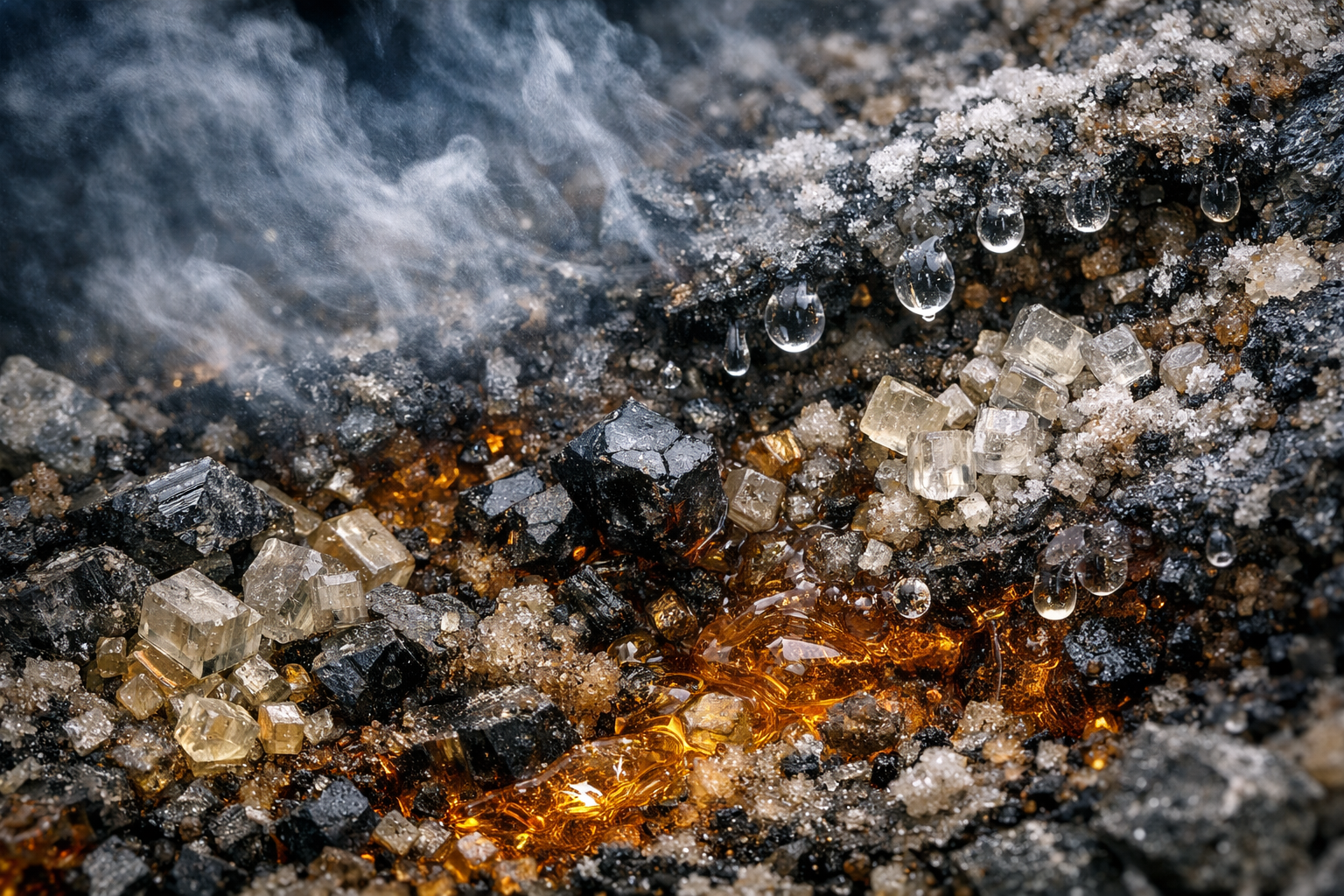
⚡ Alkalis (K₂O and Na₂O) in Clinker: Chemistry, Volatilization, and Operational Effects
A comprehensive analysis of their role in clinker formation and kiln stability
Alkalis—primarily potassium oxide (K₂O) and sodium oxide (Na₂O)—are minor constituents in clinker but exert major influence on the chemical equilibrium, thermal stability, and operational behavior of the kiln system. Their volatility and strong interactions with sulfur, chlorine, silica, and alumina make them key regulators of clinker quality and process efficiency.
🧪 1. Origins and Sources of Alkalis
Alkalis enter the process through several pathways:
- Clays and marls: contain feldspars and micas rich in K and Na.
- Solid fuels: coal, petcoke, and biomass release volatile alkalis.
- Alternative fuels: industrial residues, tires, and RDF.
- Additives and correctives: fly ash, slags, and feldspathic sands.
During clinkerization, alkalis volatilize and participate in condensation–evaporation cycles that define the chemical dynamics of the kiln.
🔥 2. Thermodynamic and Kinetic Behavior
Alkalis are highly mobile between 700 °C and 1200 °C.
In the preheater and calciner zones:
- They volatilize as KCl, NaCl, K₂SO₄, Na₂SO₄, and aphthitalite (K₃Na(SO₄)₂).
- They condense in cooler areas, especially in cyclones and ducts.
- They form closed recirculation loops, continuously cycling between gas and solid phases.
These cycles create localized enrichment zones, leading to coating formation, dust recirculation, and thermal inefficiency.
🧱 3. Alkali Phases in Clinker
In cooled clinker, alkalis are found in several distinct forms:
| Phase | Typical Composition | Characteristics |
|---|---|---|
| Aphthitalite | K₃Na(SO₄)₂ | Saline, soluble, crystallizes from the melt. |
| K₂SO₄ / Na₂SO₄ | Alkali sulfates | Form in the liquid phase during cooling. |
| KCl / NaCl | Alkali chlorides | Highly volatile, responsible for ring formation. |
| Incorporation in C₃A | (Ca₂Al₂O₅·Na₂O/K₂O) | Alters C₃A reactivity and hydration behavior. |
Though these phases represent less than 1% of clinker, their chemical impact is significant.
⚙️ 4. Effects on Kiln Operation
Alkalis are among the primary causes of kiln instability:
- Ring and coating formation: due to reactions with silica and sulfur.
- Cyclone blockages: from condensation of alkali salts.
- Recirculation cycles: increase dust load and reduce heat efficiency.
- Refractory corrosion: in high-condensation zones.
- Melt viscosity changes: affect C₃S and C₂S formation.
Effective alkali control is essential for maintaining thermal and chemical stability.
🧩 5. Critical Chemical Interactions
Alkalis interact dynamically with other kiln components:
- Alkalis + Sulfur → balanced ratio prevents incrustations.
- Alkalis + Chlorides → volatile salts cause rings and blockages.
- Alkalis + Al₂O₃ → modify C₃A reactivity and hydration.
- Alkalis + SiO₂ → form alkali silicates in the melt.
The alkali–sulfur–chlorine balance is the cornerstone of kiln stability and gas chemistry.
🧠 6. Impact on Cement Quality
In cement, alkalis influence several key properties:
- C₃A reactivity: accelerates hydration and ettringite formation.
- Potential expansion: through alkali–silica reaction (ASR) with reactive aggregates.
- Admixture compatibility: affects dispersion and setting behavior.
- Color and texture: may alter cement tone due to salt presence.
For this reason, standards limit Na₂Oeq (Na₂O + 0.658 K₂O) to ≤ 0.6 % for general-purpose cements.
🧭 7. Control Strategies
To mitigate alkali-related issues:
- Optimize raw mix chemistry: maintain balanced alkali–sulfur ratio.
- Control preheater temperature: avoid condensation zones.
- Use low-alkali fuels and additives.
- Monitor Na₂Oeq in clinker and cement.
- Implement dust purging systems.
These measures reduce volatilization cycles and enhance kiln stability.
📌 Executive Summary
Alkalis (K₂O and Na₂O) are small in quantity but large in consequence.
Their control ensures:
- Stable kiln operation.
- Prevention of rings and buildups.
- Consistent clinker quality.
- Compliance with durability standards.
In cement engineering, alkalis serve as the invisible thermometer of chemical balance and process health.