
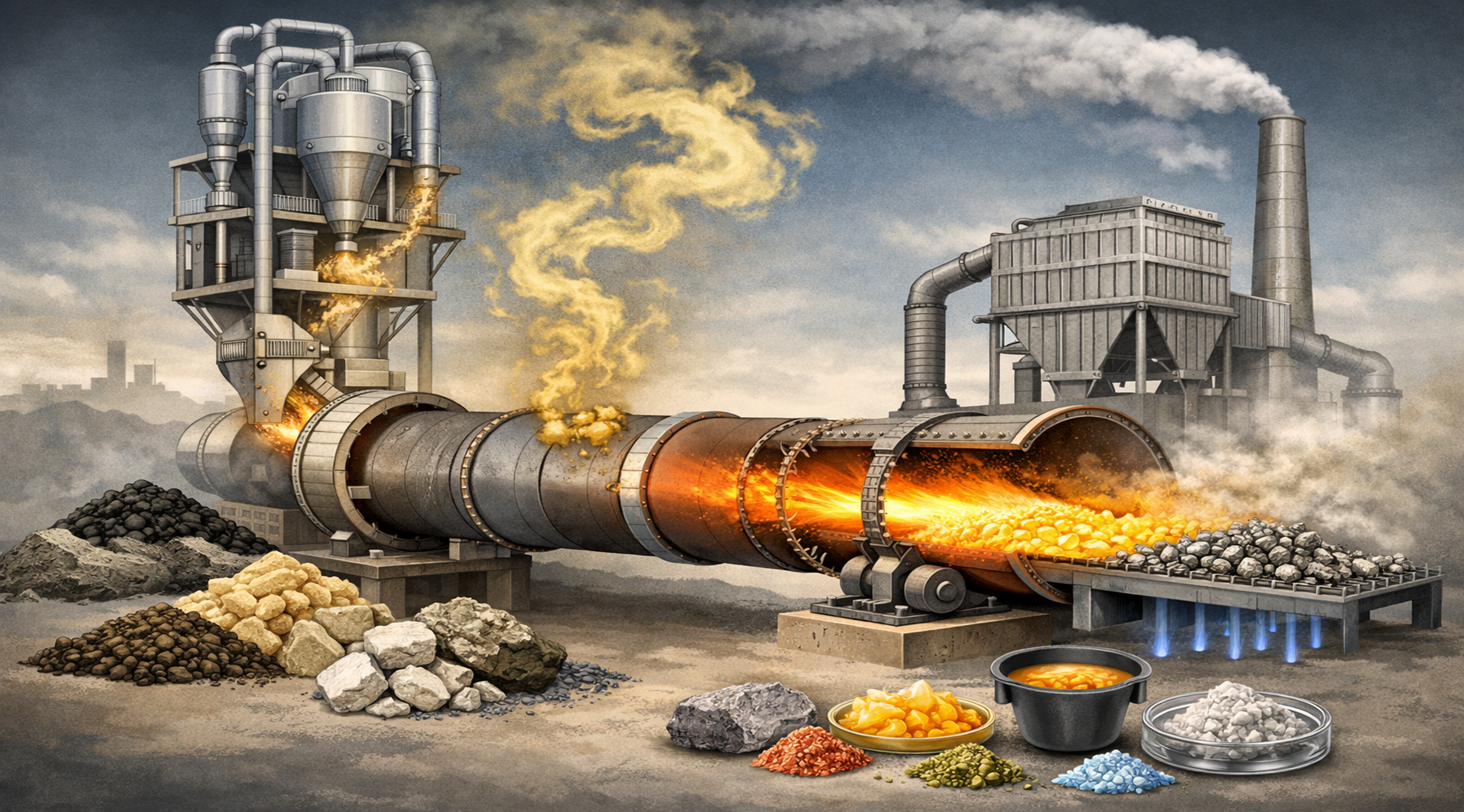
Sulfur (SO₃) in Clinker: Behavior, Equilibria, and Its Impact on Kiln Operation and Cement Quality
Sulfur—present mainly as sulfur trioxide (SO₃) in clinker—is one of the most influential minor components in the clinkerization process. Although typically found in small quantities (0.5–2.5 %), its impact on liquid phase formation, volatilization–condensation cycles, build‑up formation, and cement reactivity is profound and multifaceted.
SO₃ enters the system from three primary sources:
- Fuels (coal, petcoke, alternative fuels).
- Raw materials (pyrite, residual gypsum, sulfur-bearing minerals).
- Kiln atmosphere (oxidation of SO₂ to SO₃).
Its behavior depends heavily on the alkali–sulfur balance, temperature, availability of CaO, and the volatility of alkali compounds.
1. Chemical Forms of SO₃ in Clinker
SO₃ can be present in several distinct forms:
1.1. Calcium sulfates (CaSO₄)
- The predominant form when the alkali–sulfur balance is controlled.
- Stable between 900–1200 °C.
- Excess CaSO₄ can react with C₃A during grinding and alter hydration behavior.
1.2. Alkali sulfates (K₂SO₄, Na₂SO₄)
- Formed when alkalis are available to combine with SO₃.
- Highly volatile and central to internal circulation cycles.
- May crystallize as arcanite (K₂SO₄) or thenardite (Na₂SO₄).
1.3. Double sulfates (Langbeinite, Glaserite)
Complex phases such as:
- K₂SO₄·2CaSO₄
- 3K₂SO₄·Na₂SO₄
These form under conditions of excess alkalis and SO₃ and directly influence liquid phase viscosity.
1.4. SO₃ incorporated into clinker phases
- Small amounts may enter C₃A and C₄AF structures.
- This affects crystallinity and reactivity.
2. The Sulfur Volatilization–Condensation Cycle
Sulfur is one of the most active elements in the kiln due to its high volatility.
2.1. In the flame zone
- Fuel sulfur oxidizes to SO₂, then to SO₃.
- Above 1200 °C, SO₃ reacts with CaO to form CaSO₄.
2.2. In the preheater
- Gaseous SO₃ condenses on cooler particles.
- Reacts with alkalis to form alkali sulfates.
- These compounds volatilize again when reintroduced into the kiln.
2.3. Consequence: internal cycles
- SO₃ may recirculate dozens of times before exiting through clinker or exhaust gases.
- This leads to accumulation zones, build‑ups, and rings.
3. The Alkali–Sulfur Balance: The Critical Parameter
The most important control variable for SO₃ behavior is:
Alkali–Sulfur Ratio = Na2Oeq / SO3
Operational interpretation
- < 1.0 → Excess sulfur → Risk of rings and build‑ups.
- ≈ 1.0 → Stable equilibrium → Smooth kiln operation.
- > 1.0 → Excess alkalis → Formation of volatile alkali salts.
Process implications
- When SO₃ exceeds the alkali capacity, the excess forms CaSO₄, which may decompose and recirculate.
- When alkalis exceed SO₃, volatile alkali salts form, causing preheater blockages and circulation loops.
4. Effects of SO₃ on Clinkerization
4.1. Influence on liquid phase
- SO₃ lowers the temperature of liquid phase formation.
- Excess SO₃ increases liquid viscosity.
- Alters crystallization of C₃S and C₂S.
4.2. Formation of rings and build‑ups
SO₃ is a major contributor to:
- Rings in the transition zone.
- Build‑ups in the calcining zone.
- Cyclone blockages due to alkali sulfates.
4.3. Kiln stability
- Excess SO₃ → unstable operation, temperature fluctuations, reduced production.
- Balanced SO₃ → stable flame, improved C₃S formation.
5. Effects of SO₃ on Clinker and Cement Quality
5.1. Clinker reactivity
- SO₃ incorporated into C₃A reduces its reactivity.
- Excess sulfates may inhibit C₃S formation.
5.2. Cement hydration
- Clinker SO₃ adds to the gypsum added during grinding.
- Influences formation of ettringite and monosulfate.
- Affects:
- Setting time
- Expansion
- Early strength
5.3. Standards and limits
- Cement SO₃ is typically limited to 2.5–4.0 %.
- Clinker SO₃ must be controlled to avoid gypsum overdosing.
6. Controlling SO₃ in Kiln Operation
6.1. Fuel control
- Reduce high‑sulfur fuels.
- Optimize air–fuel ratio to minimize residual SO₂.
6.2. Raw material control
- Avoid clays or limestones with pyrite or residual gypsum.
- Monitor seasonal variability.
6.3. Alkali–sulfur balance control
- Adjust raw mix composition.
- Manage alkali volatility.
- Maintain Na₂Oeq/SO₃ near 1.0.
6.4. Temperature control
- Avoid cold zones that promote condensation.
- Maintain stable thermal profiles.
7. Executive Summary (ENGYKO Style)
SO₃ is a minor component with major impact.
Controlling it is essential for:
- Kiln stability and reduced build‑ups
- Proper liquid phase formation and C₃S development
- Maintaining alkali–sulfur equilibrium
- Clinker and cement quality
- Compliance with standards and emission reduction