
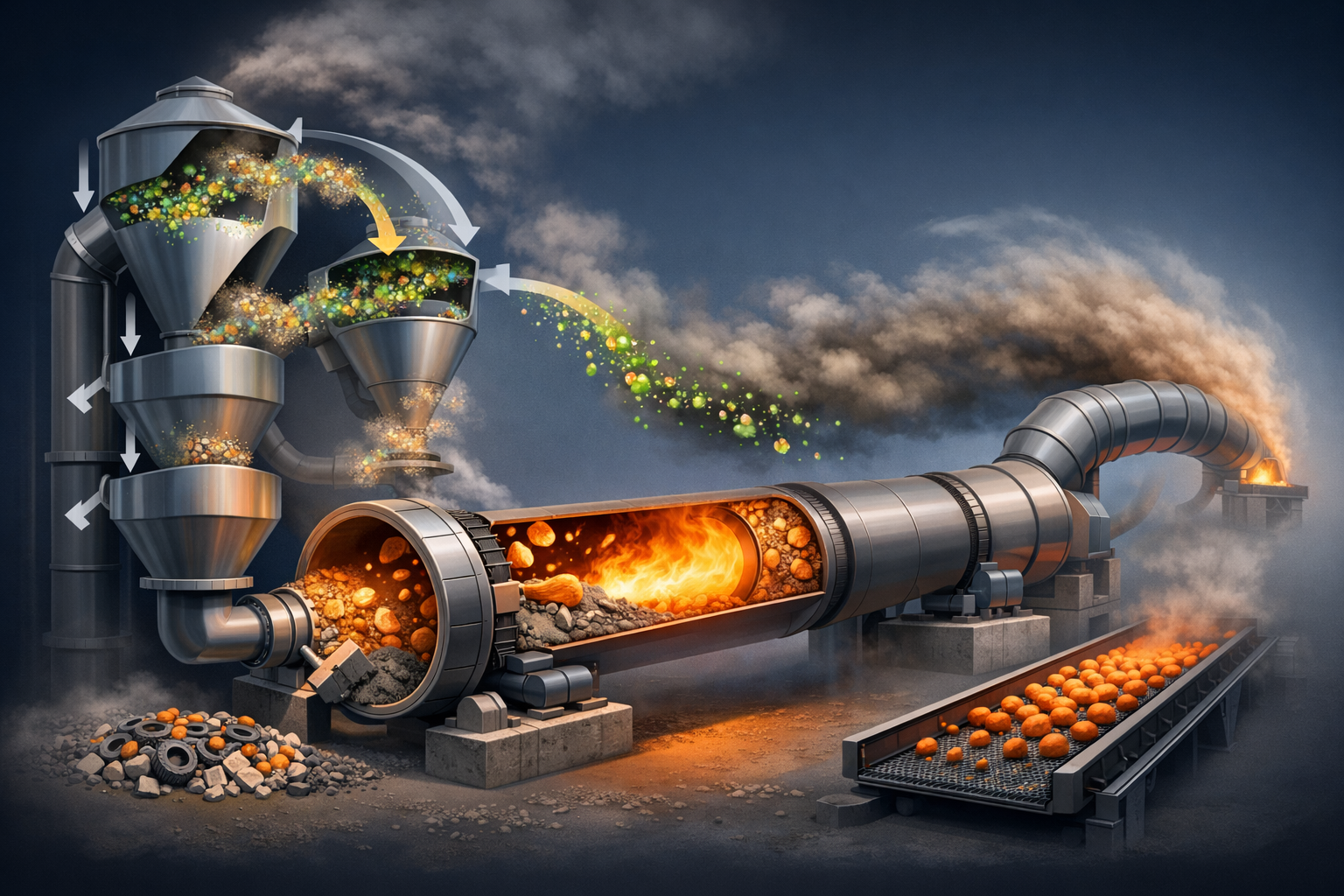
Chlorides in Clinker: Chemistry, Volatilization Cycles, and Operational Impact on the Rotary Kiln
Chlorides (Cl⁻) are among the most influential minor components in clinker manufacturing. Although their concentration in the final product is typically low, their high volatility, their ability to form condensable alkali salts, and their strong influence on kiln stability make them a critical factor in the thermal and chemical behavior of the entire pyroprocess.
This article provides a deep technical analysis of their origin, reactions, volatilization cycles, impact on clinker formation, and the operational strategies required to control them.
1. Sources of Chlorides in the Cement Process
Chlorides enter the kiln system through several pathways:
1.1. Raw materials
- Clay with trace chloride content
- Marine or evaporitic limestone
- Contaminated corrective materials
1.2. Fuels
- Coal containing chlorides
- Alternative fuels (biomass, RDF, industrial residues)
1.3. Additives
- Sand or clay contaminated with salts
1.4. Internal recirculation
- Condensed chlorides in upper cyclones returning to the kiln feed
Even small inputs can cause major effects due to their extreme volatility.
2. Chloride Chemistry in the Kiln System
2.1. Formation of alkali chlorides
Chlorides react with alkalis (K₂O and Na₂O) to form:
- KCl (sylvite)
- NaCl (halite)
These salts exhibit:
- Low melting points
- High volatility at precalciner and kiln temperatures
- Strong tendency to condense in colder zones
2.2. The volatilization–condensation cycle
Chlorides participate in one of the most aggressive cycles in the kiln system:
- Volatilization in the burning zone and sintering area
KCl(s) → KCl(g) - Transport in the gas phase toward upper cyclones
- Condensation in colder areas (cyclones 4–5)
KCl(g) → KCl(s) - Deposit formation and agglomeration
- Return of condensed material to the kiln, restarting the cycle
This cycle can multiply the effective chloride concentration far beyond the original input.
3. Operational Impact of Chlorides in the Kiln
3.1. Ring formation and blockages
Chlorides are a major contributor to:
- Rings in the transition zone
- Blockages in upper cyclones
- Build-ups in the gas duct
Condensed alkali salts act as binders, capturing fine raw meal particles.
3.2. Thermal instability
Chloride-induced deposits disrupt:
- Gas flow
- Heat distribution
- Heat exchange efficiency
Leading to:
- Fluctuating kiln outlet temperatures
- Reduced precalciner efficiency
- Increased specific heat consumption
3.3. Effects on clinker formation
Chlorides can:
- Modify liquid phase viscosity
- Influence C₃S crystallization
- Increase the reactivity of C₃A
- Promote the presence of saline phases in clinker
Excess chloride may produce clinker with:
- Poor nodulization
- Excessive glassy texture
- Variability in reactivity
4. Effects on Cement Quality
Although most chlorides volatilize, a fraction remains in the clinker.
4.1. Hydration impact
Chlorides can:
- Accelerate C₃A hydration
- Modify ettringite and monosulfate formation
- Increase gypsum demand to control setting
4.2. Steel corrosion
Chloride limits in cement are regulated due to:
- Risk of pitting corrosion in reinforced concrete
- Formation of chloride–hydroxide complexes that destabilize the passive layer
5. Critical Interactions with Other Components
5.1. Chlorides and alkalis
The Cl⁻/alkali ratio determines:
- The amount of volatile salts
- The severity of recirculation cycles
- The likelihood of cyclone build-ups
5.2. Chlorides and sulfur
The alkali–sulfur–chloride balance is essential:
- SO₃ tends to “capture” alkalis as sulfates
- Excess chlorides divert alkalis toward KCl/NaCl
- This reduces stable sulfate formation and increases volatility
The result is:
More cycles, more deposits, more instability.
6. Strategies for Controlling Chlorides
6.1. Gas bypass
The most effective method to:
- Reduce chloride recirculation
- Stabilize the preheater
- Minimize rings and blockages
The bypass extracts chloride-rich gases before condensation occurs.
6.2. Raw material control
- Select limestone with low chloride content
- Monitor clay contamination
- Control alternative fuel quality
6.3. Alkali–sulfur balance optimization
- Adjust SO₃ in raw meal or fuel
- Control Na₂Oeq
- Manage volatilization behavior
6.4. Preheater thermal management
- Avoid cold spots where KCl condenses
- Optimize cyclone temperature profiles
7. Executive Summary
Chlorides are small in quantity but enormous in impact.
- They create highly aggressive volatilization–condensation cycles.
- They form alkali salts that cause deposits, rings, and blockages.
- They destabilize the thermal profile of the kiln and reduce heat efficiency.
- They influence clinker crystallization and cement reactivity.
- Effective control requires bypass systems, alkali–sulfur balance, and raw material management.