
Fluorides in Clinker: Mineralizers, Thermodynamics, and Operational Effects
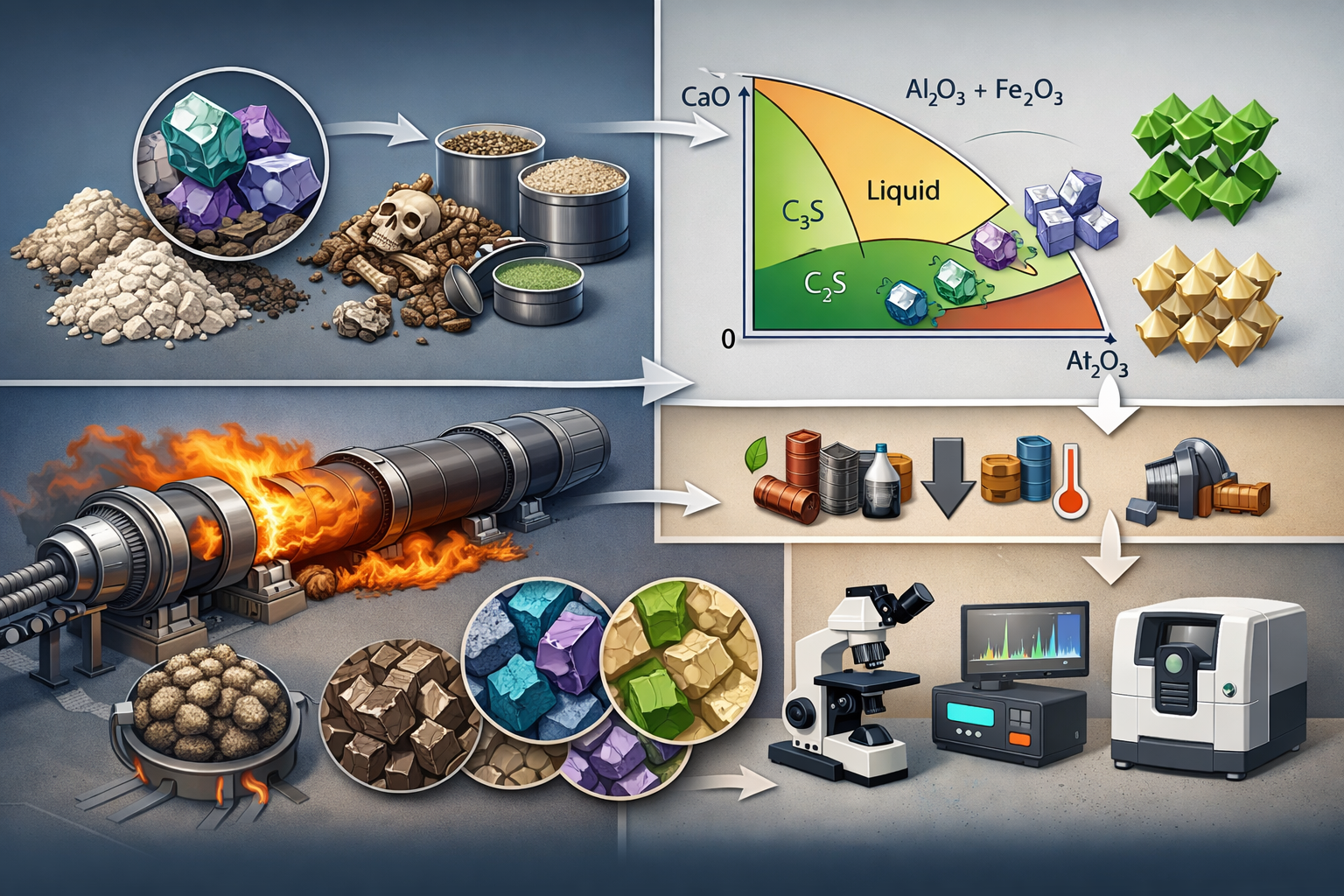
1. Chemical identity and origin of fluorine in clinkerization
Fluorides in clinker mainly originate from:
- Raw materials: clays containing traces of fluorite (CaF₂) or other fluorinated minerals.
- Alternative fuels: animal meal, industrial residues, sludge, etc.
- Mineralizing additives: intentional addition of CaF₂ to lower clinkerization temperature.
Within the CaO–SiO₂–Al₂O₃–Fe₂O₃ system, fluorine is incorporated as:
- Residual fluorite (CaF₂).
- Transient fluoroaluminates and fluorosilicates in the liquid phase.
- Isomorphic substitution within the lattice of C₃S and C₂S.
2. Role of fluorine as a mineralizer
Fluorine is one of the most effective mineralizers in cement manufacture. Its action is based on:
2.1 Lowering the formation temperature of C₃S
CaF₂:
- Reduces the eutectic temperature of the system.
- Enhances ionic mobility in the melt.
- Promotes CaO–SiO₂ diffusion, accelerating alite formation.
Typical effect:
Reduction of 50–100 °C in effective clinkerization temperature.
2.2 Increasing the liquid phase
Fluorine promotes:
- Greater melt formation at lower temperatures.
- Lower‑viscosity melts, improving sintering.
Resulting in:
- Better nodulization.
- Higher clinker density.
- Lower specific thermal consumption.
3. Effects on main clinker phases
3.1 C₃S (Alite)
Fluorine can enter the C₃S structure:
- Reduces crystal size.
- Increases early reactivity.
- Alters morphology toward rounded crystals.
However, excess fluorine may:
- Produce less stable alite.
- Increase decomposition tendency during cooling.
3.2 C₂S (Belite)
Fluorine:
- Stabilizes β‑C₂S, the hydraulically active form.
- Reduces formation of inert γ‑C₂S.
Improving overall clinker reactivity.
3.3 C₃A and C₄AF
Fluorine:
- Associates with Al₂O₃ in the melt.
- Forms transient fluoroaluminates.
- Affects C₃A crystallinity.
4. Operational effects in the kiln
4.1 Benefits
- Lower flame temperature required.
- Greater stability in the burning zone.
- Improved sintering at equal thermal input.
- Reduced fuel consumption.
4.2 Risks and adverse effects
If fluorine is excessive or unevenly distributed:
- Overly fluid melts → risk of ring formation in the transition zone.
- Increased volatilization and internal recirculation.
- Interaction with alkalis → formation of alkali fluorosilicates.
- Impact on refractory stability.
5. Impact on cement quality
5.1 Advantages
- Higher early reactivity.
- Improved effective fineness (lower grinding energy).
- More homogeneous clinker with finer crystals.
5.2 Considerations
- Excess fluorine may yield cements with higher heat of hydration.
- Possible variation in long‑term strength if alite becomes unstable.
- Changes in C₃A hydration kinetics.
6. Analytical control of fluorine in clinker
Common methods:
- XRF: total F quantification.
- SEM–EDS: identification of fluorinated phases.
- X‑ray diffraction: lattice parameter changes in C₃S.
- Thermogravimetry: phase decomposition effects.
Typical industrial range:
- 0.05–0.3 % F (depending on raw materials and mineralizer use).
7. Executive summary
Fluorine = strategic mineralizer.
In small amounts, it transforms clinkerization:
- Lowers sintering temperature.
- Increases liquid phase and nodulization.
- Boosts clinker reactivity.
- Reduces thermal consumption.
But in excess:
- Produces overly fluid melts.
- Intensifies volatilization and internal cycles.
- Damages refractory stability.
Fluorine control is essential to optimize thermal efficiency, kiln stability, and cement quality.