
1. SPAR‑H: Purpose and Mechanism
SPAR‑H was designed to estimate the probability of human error in industrial tasks through two main components:
1.1 Base Probabilities
SPAR‑H distinguishes between two task types:
- Diagnosis (interpretation, decision‑making, analysis) → base probability ≈ 0.01
- Action (execution, pressing, opening, closing) → base probability ≈ 0.001
This distinction reflects a simple truth: thinking fails more often than doing.
1.2 Performance Shaping Factors (PSFs)
SPAR‑H adjusts the base probability using eight PSFs:
- Available time
- Stress
- Task complexity
- Experience / training
- Procedures
- Human‑machine interfaces
- Communication
- Environment
Each PSF can be “good,” “nominal,” “degraded,” or “severely degraded,” and each state multiplies the base probability.
2. Why SPAR‑H Fails in Petroleum Operations
The nuclear industry operates in highly controlled environments. Oil and gas operations, by contrast, occur in:
- extreme noise and vibration
- heat and humidity
- severe weather
- variable lighting
- confined spaces
- degraded communication
- physically demanding tasks
- rapidly changing conditions
These realities cause multiple PSFs to degrade simultaneously, something SPAR‑H was never designed to handle.
3. Critical PSFs Underestimated by SPAR‑H
3.1 Environment
In petroleum, the environment is not a secondary factor—it is a dominant multiplier of human error.
Noise, heat, vibration, wind, poor lighting, and slippery surfaces affect:
- perception
- communication
- execution
- available time
- stress
SPAR‑H treats environment as an independent PSF, but in petroleum it degrades several PSFs at once.
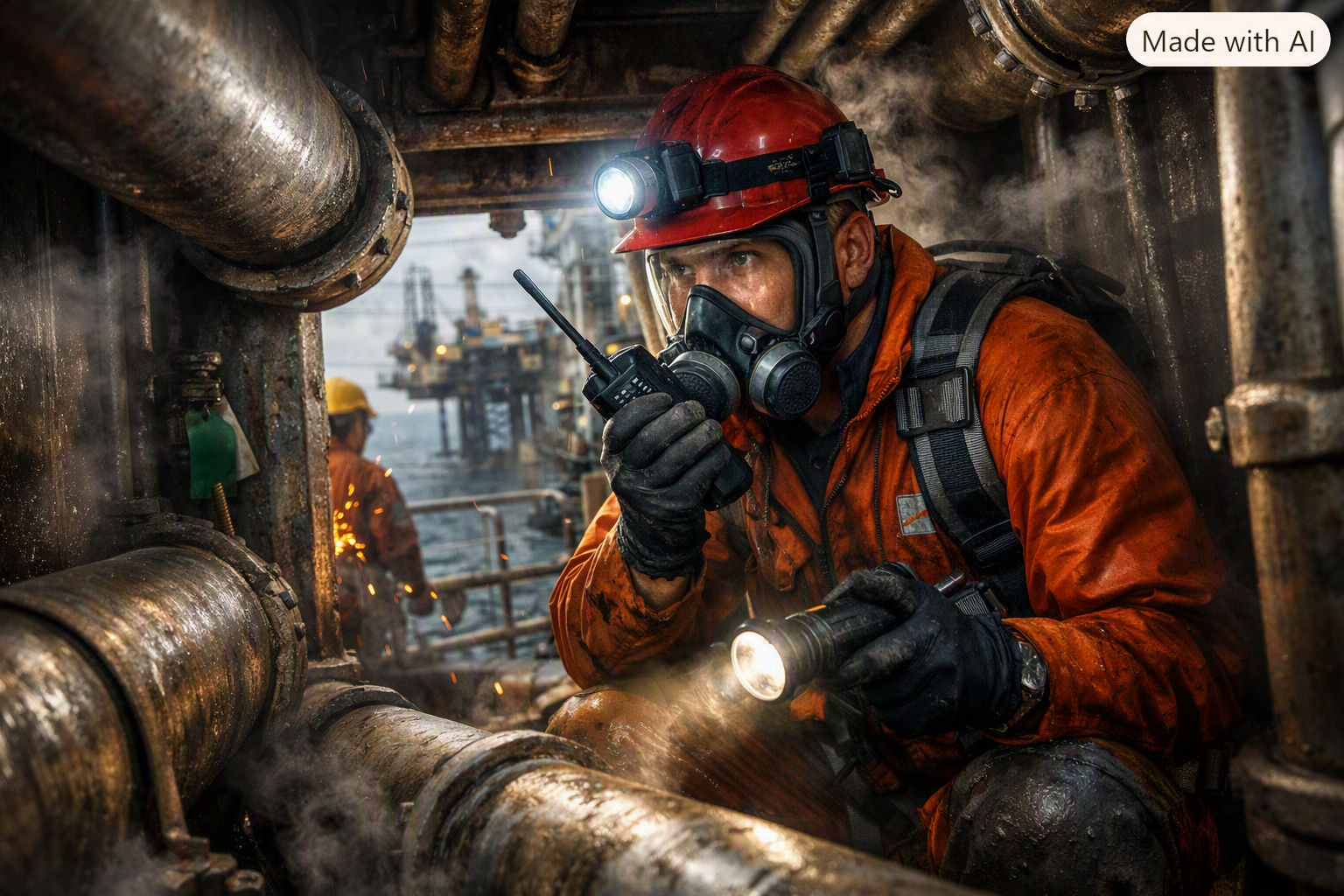
3.2 Confined Spaces
Confined spaces are among the most critical scenarios.
They simultaneously degrade all PSFs:
- Time → entry and exit are slow and risky
- Stress → claustrophobia, heat, hazardous atmospheres
- Complexity → physical difficulty increases
- Procedures → steps cannot always be executed as written
- Interfaces → instruments may be inaccessible or invisible
- Communication → voice and radio signals are limited
- Training → prior experience may not apply
- Environment → inherently degraded
SPAR‑H was not built for situations where all PSFs collapse together.
3.3 Communication
Degraded communication is one of the most dangerous PSFs.
When an operator cannot report that something is wrong, the system loses:
- early detection
- error correction
- coordination
- feedback
- administrative barriers
The most dangerous human error is not the one that occurs— it is the one no one detects.
SPAR‑H does not adequately model this loss of detection.
4. How Petro‑HRA Modifies SPAR‑H
Petro‑HRA acknowledges that SPAR‑H underestimates human risk in petroleum and introduces several key changes:
4.1 New Degradation Levels for PSFs
Especially for:
- environment
- communication
- complexity
- interfaces
- procedures
4.2 Revised Multipliers
Higher multipliers for:
- severely degraded communication
- extreme environmental conditions
- confined‑space operations
- tasks with high physical load
4.3 Interaction Between PSFs
SPAR‑H assumes independence among PSFs. Petro‑HRA incorporates interactions, particularly in:
- confined spaces
- extreme weather
- tasks with limited communication
4.4 Petroleum‑Specific Guidelines
Including:
- task analysis for oil and gas operations
- field data collection
- classification of critical tasks
- integration with quantitative risk assessment (QRA)
- contextual adjustment of base probabilities
5. Practical Example: Operator in a Confined Space with Limited Communication
SPAR‑H Original
- Action task → 0.001
- Degraded communication → moderate multiplier
- Degraded environment → moderate multiplier
Result: underestimated probability.
Petro‑HRA
- Action task → 0.001
- Severely degraded communication → high multiplier
- Extreme environment → high multiplier
- Physical complexity → additional multiplier
- PSF interaction → compounded multiplier
Result: more realistic, higher probability of human error.
6. Implications for QRA and Risk Management
Petro‑HRA enables organizations to:
- identify truly critical human tasks
- adjust procedures and work permits
- improve communication in confined spaces
- redesign interfaces and access points
- train operators under realistic conditions
- strengthen administrative barriers
- integrate human error into QRA with greater accuracy
7. Conclusion
SPAR‑H remains a valuable method, but its nuclear‑industry design does not reflect the complexity of petroleum operations. Petro‑HRA modifies SPAR‑H to capture environments where communication, physical complexity, and environmental stress degrade performance simultaneously. The result is a more precise, practical, and risk‑aligned approach to human reliability analysis in oil and gas.